
Texas evictions: $1,000 flat attorney fee — $0 to start, billed per completed stage. A real attorney, not an agent service.
Notice, filing, citation, trial representation, and the writ — handled and signed by a licensed Texas attorney, filed under the new statewide eviction rules effective January 2026. Court costs are set by your county and itemized before you pay; many low-cost Texas eviction services are not law firms and never put an attorney on your case. We are, and we do.
What to expect in Texas
Uniform statewide procedure
Texas rewrote eviction procedure effective Jan 1, 2026 (SB 38 / Rule 510). One rule set, all 254 counties, no local surprises.
Fast timelines
Trial is set 10–21 days after filing; typical uncontested cases run three to five weeks from notice to writ. Courts control the calendar; timelines vary.
First-delinquency rule
Since 2026, a first missed payment requires a pay-rent-or-vacate notice. Our engine tracks this automatically — a common DIY mistake.
E-filed same day
We file through eFileTexas the same business day your case clears attorney review.
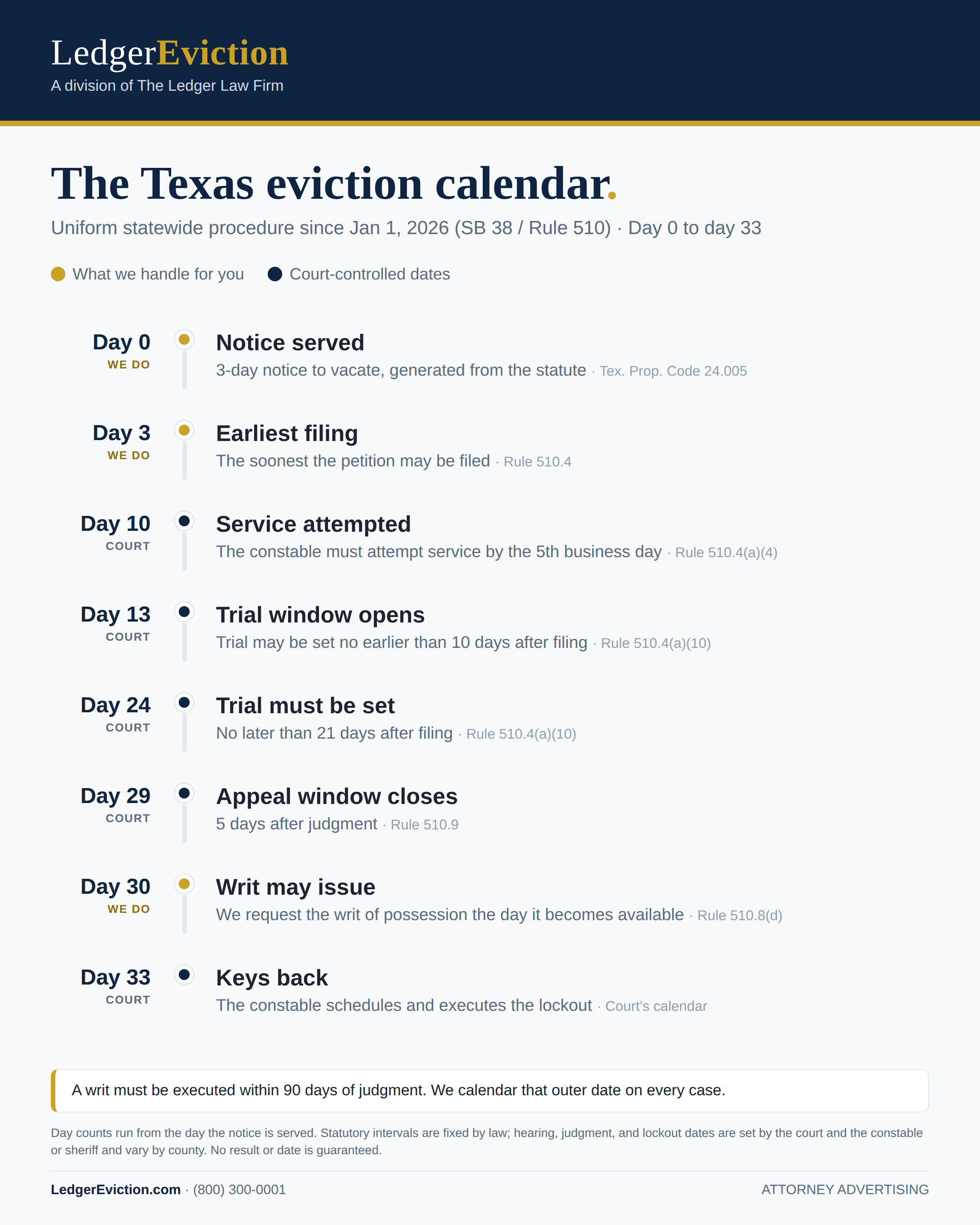
The Texas calendar, day by day
Uniform statewide procedure since Jan 1, 2026 (SB 38 / Rule 510).
- Day 0USNotice servedSET BY LAW3-day notice to vacate, generated from the statute and served for you.Tex. Prop. Code 24.005
- Day 3USEarliest filingSET BY LAWThe soonest the petition may be filed. We e-file through eFileTexas the same business day the case clears attorney review.Rule 510.4
- Day 10COURTService attemptedSET BY LAWThe constable must attempt service by the 5th business day after filing.Rule 510.4(a)(4)
- Day 13COURTTrial window opensSET BY LAWTrial may be set no earlier than 10 days after filing.Rule 510.4(a)(10)
- Day 24COURTTrial must be set bySET BY LAWNo later than 21 days after filing. Your attorney appears - you do not need to.Rule 510.4(a)(10)
- Day 29COURTAppeal window closesSET BY LAW5 days after judgment. If the tenant does not appeal, possession is final.Rule 510.9
- Day 30USWrit may issueSET BY LAWWe request the writ of possession the day it becomes available.Rule 510.8(d)
- Day 33COURTKeys backCOURT’S CALENDARThe constable schedules and executes the lockout.
A writ must be executed within 90 days of judgment. We calendar that outer date on every case.
Day counts run from the day the notice is served. Statutory intervals are fixed by law; hearing, judgment, and lockout dates are set by the court and the constable or sheriff and vary by county. No result or date is guaranteed.
Texas eviction questions, answered
How long does an eviction take in Texas?
Most uncontested Texas evictions run three to five weeks from notice to writ. Under the 2026 rules, trial is set 10 to 21 days after filing, and your portal shows every deadline on your case as it happens. Contested cases and appeals take longer, and we publish flat fees for those too.
What notice do I have to give before filing?
Texas requires a written notice to vacate before you can file (Tex. Prop. Code 24.005). Since January 1, 2026, a tenant's first missed rent payment generally calls for a notice to pay or vacate first, and notice can now be delivered by hand, mail, commercial carrier, or in some cases email. We prepare and serve the notice your lease and the statute actually require.
Can I file an eviction myself in Texas?
Many owners can, but Texas rewrote eviction procedure effective January 1, 2026 (SB 38 / Rule 510), and the failure points moved: notice type, service windows measured in business days, and appeal deposits are all new. A notice or filing error usually means starting the clock over. For a published flat fee, a licensed Texas attorney signs and files it right the first time.
What happens if my tenant appeals?
Under the 2026 rules an appeal no longer automatically pauses enforcement. The tenant must post the required deposit within five days and keep paying rent into the court registry while the county court holds a new trial within 21 days. We handle appeals at the flat fee published above.
Does the CARES Act still apply in 2026?
Yes. If a property has federally backed financing or participates in certain federal housing programs, federal law still requires a 30-day notice to vacate for nonpayment. Filing on a state notice for a covered property is one of the most common ways landlords lose weeks. We screen every case for CARES coverage before anything is served.
What mistakes most often delay a Texas eviction?
A notice period that does not match the lease, no proof of how notice was delivered, naming the wrong occupants, and missing the new business-day service windows. Each one can send you back to day zero. Our intake checks all of them before your case is filed.
General information about Texas law, not legal advice about your case. Every case turns on its facts.